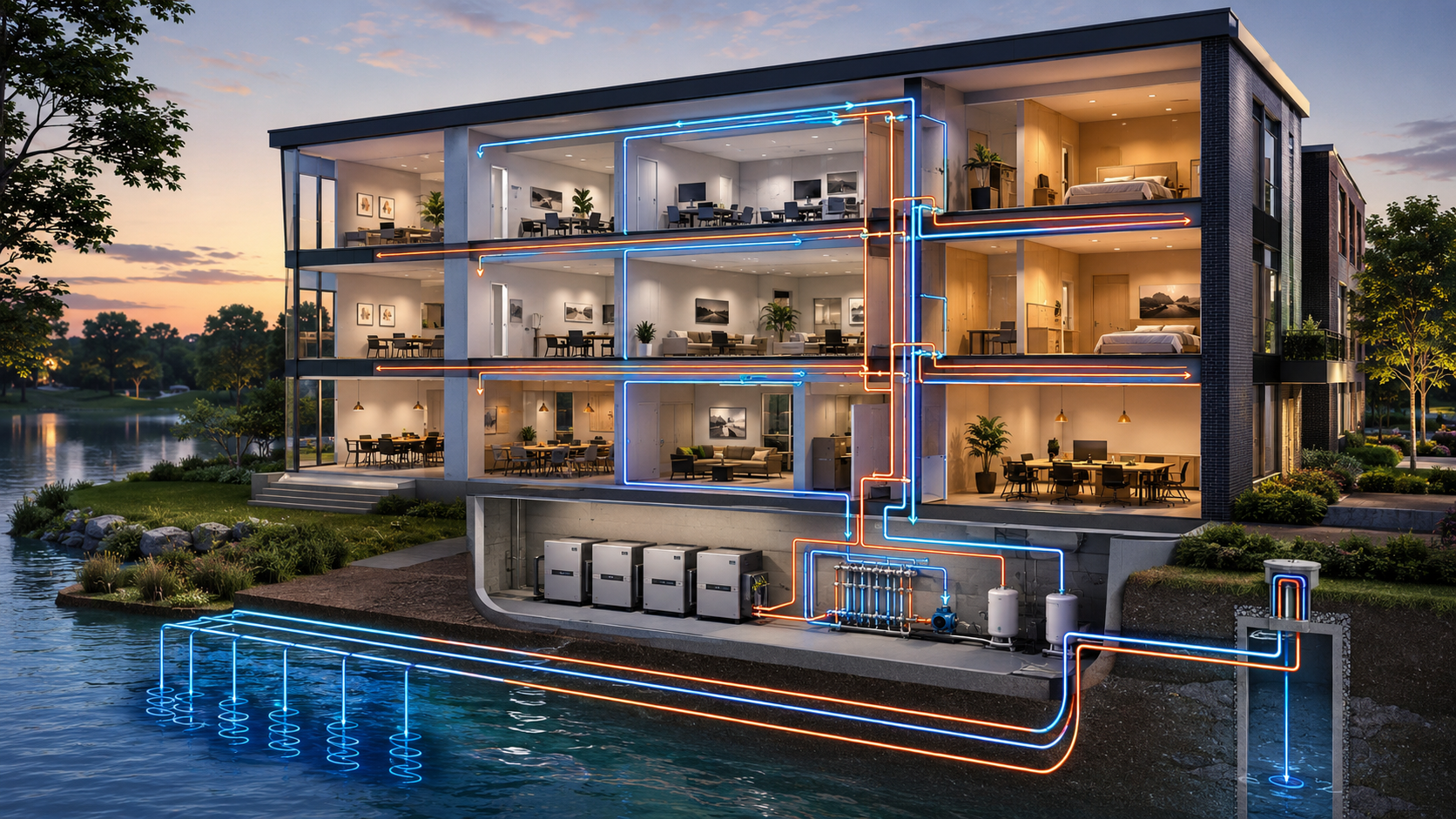
Water-Source Heat Pumps
Water-source heat pumps use water to help heat and cool buildings. Instead of collecting heat from outdoor air or from the ground, these systems exchange heat with a water source.
The water source can be groundwater, a lake, a pond, or a shared water loop inside a building or district energy system. Because water can store and transfer heat well, water-source heat pumps can be an efficient option when the location and design are suitable.
How Water-Source Heat Pumps Work
A water-source heat pump moves heat between a building and a water system.
In heating mode, the heat pump collects heat from the water source and transfers it indoors. In cooling mode, the process can reverse, removing heat from inside the building and releasing it into the water system.
Like other heat pumps, the system uses electricity, refrigerant, a compressor, and heat exchangers to move heat instead of creating all heat directly.
Common Water Sources
Water-source heat pumps can use different types of water sources depending on the project.
Groundwater
Some systems use water from wells. The water passes through a heat exchanger, and then it is returned or discharged according to local rules and system design.
Lake or Pond Water
If a property is near a suitable lake or pond, the system may use that water as a heat source or heat sink.
Building Water Loop
In some larger buildings, heat pumps are connected to a shared water loop. Individual units can add or remove heat from the loop depending on each space’s heating or cooling needs.
District Energy System
Some communities, campuses, or large developments may use shared energy systems where water is used to move heating and cooling energy between buildings.
Where Water-Source Heat Pumps Are Used
Water-source heat pumps are often used in commercial buildings, apartment buildings, hotels, schools, campuses, and larger developments.
They can be useful when different parts of a building need heating and cooling at the same time. For example, one area may need cooling while another area needs heating. A shared water loop can help transfer energy within the building more efficiently.
Benefits of Water-Source Heat Pumps
Water-source heat pumps can provide both heating and cooling. They can also be efficient because water is good at absorbing and releasing heat.
In larger buildings, water-loop systems can offer flexible temperature control for different rooms, units, or zones. They may also support lower-emission buildings when powered by cleaner electricity.
Things to Consider
Water-source systems are not suitable for every property. They require proper design, access to a suitable water source or water loop, and professional installation.
For systems using lakes, ponds, or groundwater, water quality, environmental rules, permits, maintenance, and local regulations must be considered. The system must be designed carefully to protect the water source and maintain reliable performance.
Water-Source Heat Pumps and Sustainable Buildings
Water-source heat pumps can support sustainable building design, especially in larger projects. They can work with energy-efficient building envelopes, smart controls, district energy systems, and renewable electricity.
When properly designed, they can help reduce energy waste and improve comfort across different parts of a building.
Final Thought
Water-source heat pumps are a powerful option for certain buildings and sites. They may not be as common for simple residential projects, but they can be very useful in larger buildings, multi-unit developments, and district energy systems where water can be used effectively for heating and cooling.